Persistent Fatigue? Your «Cellular Engine» Might Be Damaged.
Discover what mitochondrial dysfunction is and how scientific evidence suggests you can repair your cells naturally.
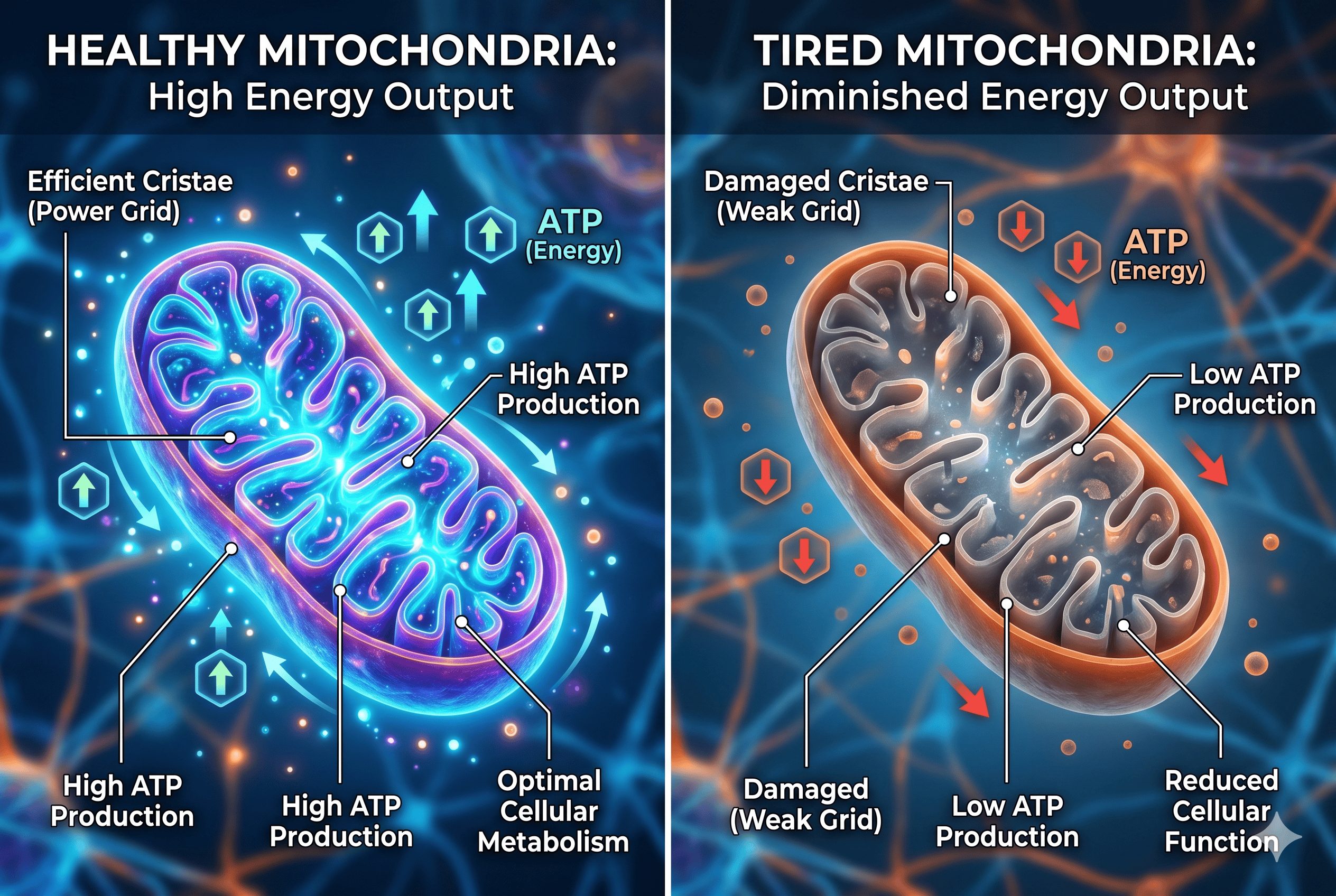
If you wake up tired, feel a «brain fog» mid-day, or your body takes days to recover from minimal effort, the problem isn’t your age. It’s your cellular ATP production.
Inside your cells are thousands of tiny power plants called mitochondria. Their job is to convert food and oxygen into ATP (Adenosine Triphosphate), the «energy currency» your body needs for everything from moving a muscle to thinking a thought.
Mitochondrial Dysfunction Symptoms: When the Engine Fails
When these plants become damaged — due to oxidative stress, poor nutrition, or natural aging — energy production drops dramatically. This is known as mitochondrial dysfunction.
- Chronic fatigue that does not improve with rest.
- Difficulty focusing and short-term memory loss (brain fog).
- Painfully slow muscle recovery.
- Generalized weakness.
- Slow metabolism and difficulty losing weight.
The good news is that mitochondria are dynamic. They have the capacity to self-repair and create new ones (a process called mitochondrial biogenesis) if they receive the exact molecular nutrients.
The Science Behind Cellular Repair CLINICAL EVIDENCE
Advanced clinical studies have identified a handful of ingredients that can cross the cellular membrane and work directly in the heart of the mitochondria:
1. CoQ10 (Ubiquinol): Vital for the electron transport chain that generates ATP. Studies on PubMed prove that CoQ10 reduces fatigue in patients with chronic low cellular energy.
2. PQQ (Pyrroloquinoline quinone): This is a fascinating discovery. Science has proven that PQQ is capable of **stimulating mitochondrial biogenesis**; meaning, it helps your cells create *new* mitochondria.
3. L-Carnitine + Alpha-Lipoic Acid: A clinically-proven synergy in older rats demonstrated a reversal of mitochondrial decline, restoring the vitality of aged rats to levels seen in young rats.

How to Implement This Molecular Synergy Naturally?
Obtaining clinical doses of CoQ10, PQQ, and L-Carnitine through food alone is practically impossible. A protocol-based supplementation approach with high bioavailability is required.
Dr. Shallenberger has developed a formula that combines precisely these ingredients in the correct proportions to maximize the scientific synergy of mitochondrial repair.
Does this ingredient synergy work in the real world?
Read our complete, honest technical analysis.
Read the Scientific Formula Review →